
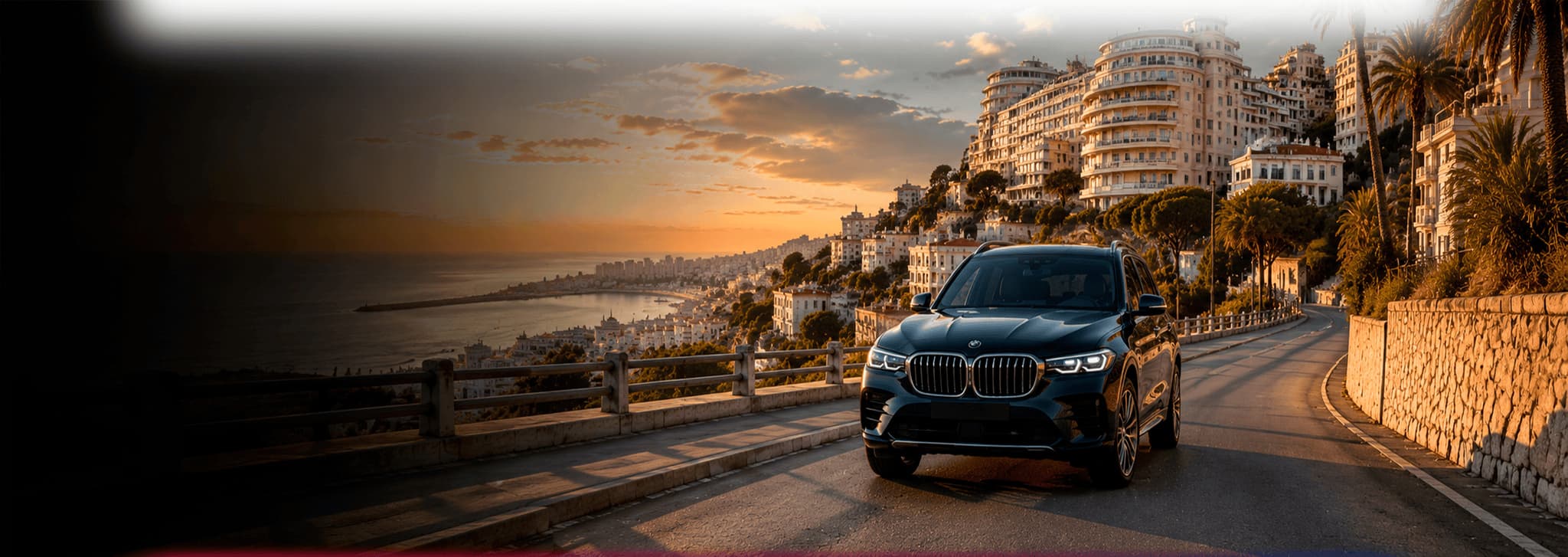
The District Tourists Don't Know Yet
Most visitors to Algiers know the Casbah, the Botanical Garden, Notre-Dame d'Afrique. Télemly, on the other hand, stays off the radar. That is precisely what makes it one of the most fascinating districts in the capital.
Perched on a hillside overlooking the bay, this residential district of Algiers-Centre packs, within a few hundred metres of winding boulevard, an extraordinary architectural density. Buildings on stilts, a bridge-building unique in the world, 23-storey towers designed by disciples of Le Corbusier — all in the same neighbourhood, with the sea as a backdrop.
And just next door, in El Biar, the Balcon Ezzahira offers the most spectacular view in Algiers. Two hours is enough to combine both. You just need to know where to go and how to get there.
Visiting Télemly? Take a Car.
Télemly sits high on a hillside, and the Balcon Ezzahira is at 240 m altitude. Without a car, you depend on buses with unpredictable schedules — and you'll miss the best angles for photographing the Burdeau bridge-building.
Safar El Amir offers vehicles available in Algiers, with delivery possible to your hotel or to Algiers airport.
Instant confirmation, modern fleet, transparent pricing.
Book my car rental in AlgiersHistory of the Télemly District
The name tells you everything about the origins of the place. Télemly comes from Berber: two etymologies coexist — "thala oumlil" (white spring) or "thala oumeley" (shaded spring). In both cases, it's about water: the district is built on former marshland (merdja in Arabic), saturated with underground water. This is no coincidence — landslides in the El Merdja zone, between Krim-Belkacem and Colonel Bougara boulevards, have been documented for a long time, and some houses are still dangerously tilting today.
Before the 1950s, Télemly was mainly a promenade. The Boulevard du Télemly — long, winding, tree-lined — snaked along the hillside and offered strollers a stunning view over the Bay of Algiers. Trolleybuses departed from the Grande-Poste and followed this picturesque boulevard. It had another name as well: the Chemin des Aqueducs (Aqueduct Road), as it partially followed the route of Turkish water pipes dating from the 16th century.
After independence, the boulevard was renamed Salah-Bouakouir, then Boulevard Colonel Krim-Belkacem in 1992 — the name it still bears today. From the 1950s, urbanisation accelerated rapidly. Large buildings appeared, inspired by the international modernist movement. Télemly became an architectural laboratory.
Modernist Architecture: An Open-Air Museum
This is where Algiers nearly became the world capital of modernism. Le Corbusier had designed his famous Plan Obus for Algiers — a pharaonic project of viaduct-buildings running along the coast. The project was never fully realised. But his disciples did build. And the result is there, visible from the street.
Here is the architectural circuit to do on foot along Boulevard Krim-Belkacem:
The Burdeau Bridge-Building (1952)
This is the centrepiece. Designed by architect Lucien Pierre-Marie, this building is literally an inhabited bridge: it spans the Burdeau ravine on seven massive pillars, carries Boulevard Krim-Belkacem on its roof and the Rue Frères Khelifi below. It contains 82 apartments spread across several levels, plus two administrative floors and a 150-vehicle car park.
Only two exist in the world: the one in Algiers and another in Brazil, in Rio de Janeiro. Foreign tourists who discover it for the first time are often speechless — the MBC channel even dedicated a report to it in its series on overlooked architectural treasures.
The Aérohabitat (1955)
Four buildings on stilts, the tallest reaching 23 storeys. Designed by Louis Miquel, Pierre Bourlier and José Ferrer-Laloë, all members of the CIAM d'Algiers (the local Corbusian school), the Aérohabitat is Algiers' answer to the Cité Radieuse in Marseille. A "vertical village" of 300 apartments, with a commercial street inside on the 10th floor — butcher, hairdresser, grocer — accessible by public lift.
At its inauguration in 1955, it was the tallest residential building in the world. Today it remains one of the most significant achievements of the Modern Movement in Algeria.
Other Boulevard Gems
| Building | Year | Architect | Feature |
|---|---|---|---|
| Immeuble Télemly / University Works | 1953 | Bienvenu | On stilts, after Le Corbusier |
| Immeuble Lafayette | 1954 | André Cazalet | 16 storeys with original curve |
| Immeuble EGA | 1952 | Marcel-Henri Christofle | Current headquarters of Sonelgaz |
Facing the Aérohabitat stands the Villa Malglaive, in Neo-Moorish style — now the French consulate. The neighbouring former Dominican convent now houses the German Embassy and the Goethe Institut.
The Balcon Ezzahira: Algiers' Most Beautiful View?
Yes. It's hard to find anything better in the capital.
The Balcon Ezzahira — formerly the Balcon Saint-Raphaël — is located in El Biar, in the Saint-Raphaël residential neighbourhood, close to the Ministry of Justice. It sits at the top of a cliff about 20 metres high, at 240 metres altitude on the wooded El Biar plateau.
From there, the Bay of Algiers unfolds in a 180° panoramic view. The sea, the white buildings of the lower town, the heights of Bab El Oued to the left, the eastern hills to the right. On a clear day, you can see the Kabylie mountains.
A Brief History
This land first served as gardens for the Swedish consulate. In 1913, the Claridge company acquired it to build a hotel — a project that never came to fruition. In 1926, the municipalities of El Biar and Algiers bought the land and created a public terrace with a balcony at the edge of the cliff. The site was listed as scenic at that time. The balcony officially opened to the public in 1928.
When to Go?
- Golden hour (5pm–6:30pm): the raking light over the bay is spectacular, ideal for photography.
- Sunrise: for early risers, the view of the city awakening is breathtaking.
- Avoid midday in summer: the light is harsh and the heat intense.
Frequently Asked Questions
How do you get to the Télemly district from central Algiers?
By car, take Boulevard Colonel Krim-Belkacem from Algiers-Centre. Allow 10 to 15 minutes from the Grande-Poste outside rush hours. Buses also connect the centre to Télemly, but frequencies are irregular — a car remains the best option for comfortable exploration.
Can you reach the Balcon Ezzahira by public transport?
Technically yes, buses serve El Biar. But the balcony is located on Rue Buffon, in a poorly served residential neighbourhood, and the stops are far away. In practice, a car or taxi will save you a long uphill walk.
What is the best time to enjoy the view from the Balcon Ezzahira?
The golden hour, between 5pm and 6:30pm, offers the most beautiful light over the Bay of Algiers. Sunrise is also spectacular for photographers. Avoid midday in summer — the light is harsh and the heat difficult.
How much time should I allow to visit Télemly and the Balcon Ezzahira?
A half-day is enough to combine both: 1.5 to 2 hours for the Télemly architectural circuit (Burdeau bridge-building, Aérohabitat, Lafayette), 30 minutes at Beyrouth Park, then 30 to 60 minutes at the Balcon Ezzahira. Leave in the morning to finish at the balcony during the golden hour.
Can you combine Télemly with Notre-Dame d'Afrique in a half-day?
Yes, it's actually the ideal circuit. Start with Télemly in the morning (architecture, green spaces), have lunch in El Biar, then head to the Balcon Ezzahira in the early afternoon and finish at Notre-Dame d'Afrique for sunset. Both sites are 10 minutes apart by car. Find more ideas in our <a href="/en/blog/algiers/visiter-alger" class="text-[#C42A44] underline">guide to things to do in Algiers</a>.