
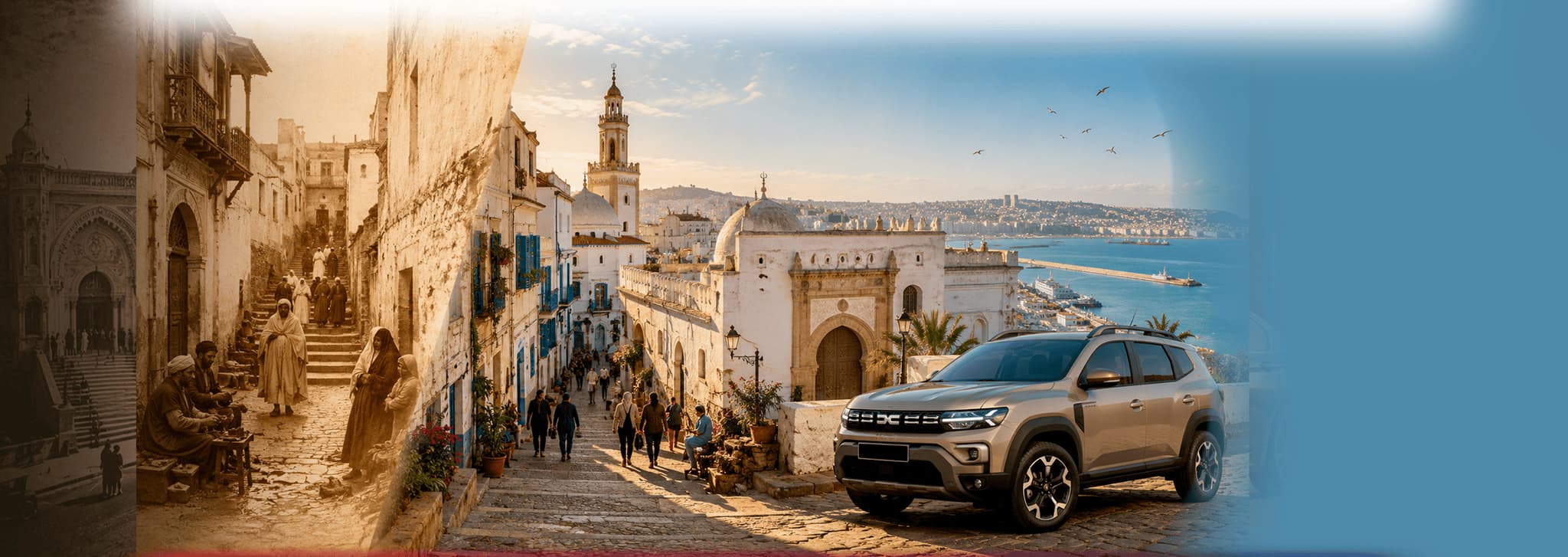
How to Get to the Casbah of Algiers?
Main entry point: Place des Martyrs
- By metro: Line 1, Tafourah – Grande Poste station (10-min walk to Place des Martyrs) or Hay El Badr station. The most convenient option if you're coming from the city centre.
- By minibus: Many lines from the city centre and Bab El Oued. Affordable, but schedules vary.
- By car: Parking available near the Port of Algiers (Boulevard Zighout Youcef). A car is especially useful if you're combining the Casbah with other Algiers sites in one day. Renting a car in Algiers with Safar El Amir lets you visit multiple sites without relying on public transport schedules.
- From Houari Boumediene Airport: The airport is 25 km from the Casbah — about 35 to 45 minutes by car depending on traffic. Renting a car at Algiers Airport lets you head straight to the Casbah on arrival, with no transfers or waiting.
What is the Casbah of Algiers?
The Casbah is the historic heart of Algiers. A 54-hectare Ottoman medina perched on a hill overlooking the Mediterranean, listed as a UNESCO World Heritage Site since 1992.
Its history dates back to the 4th century BC, when the Carthaginians established a trading post on these islets. The current urban framework took shape in the 10th century under the Berber Zirid dynasty, before reaching its peak during the Ottoman Regency.
- Lower Casbah: accessible, well-signposted, restored palaces and mosques
- Upper Casbah: labyrinthine alleys, authentic popular atmosphere
- Citadel (Dar Essoltan): highest point at ~118 m, panoramic view over the entire bay
It is also a place of national memory. This is where the Battle of Algiers unfolded in 1957, and where Ali la Pointe — an iconic figure of the Algerian resistance — met his end. Every stone tells a story. By night, the lit-up alleys give the neighbourhood a truly magical atmosphere. Discover our best ideas for an evening in Algiers.
Must-See Sites in the Casbah of Algiers
The Palais des Raïs (Bastion 23)
The Palais des Raïs is one of the most important monuments in Algiers. This complex of three Ottoman palaces (numbered 17, 18 and 23) and six fishermen's houses was built between the 16th and 18th centuries. It is also one of the last vestiges of the Casbah's former extension all the way to the sea.
Restored in the late 1980s, it now houses the Centre for Arts and Culture. Temporary exhibitions of contemporary Algerian art, a central courtyard with marble columns, carved wooden ceilings, and views over the Mediterranean from the terraces.
- Address: 23, Boulevard Amara Mohamed Rachid, Lower Casbah
- Hours: Monday–Saturday, 9 am–5 pm (closed Sunday)
- Entry: 200 DA (full price) / 140 DA (students, artists) / free (under 16 and over 65)
Mustapha Pacha Palace (Dar Mustapha Pacha)
One of the best-preserved Ottoman palaces in Algiers. It houses the Museum of Miniature and Illumination: period tiles, marble columns, a central courtyard of rare elegance. Acquired in 1798 by Dey Mustapha Pacha, it gives a precise picture of life among the Ottoman elite in Algiers.
- Hours: 10 am–6 pm, except Friday
Ketchaoua Mosque
Impossible to miss from Place des Martyrs. Built during the Ottoman period, converted into a cathedral under French colonisation in 1832, restored to Islamic worship at independence in 1962. Its architecture is a unique blend: marble columns, domes, minarets, and a portico adorned with four black marble columns.
Non-Muslims may admire the exterior freely. Interior visits are restricted to non-prayer hours.
The Citadel of Algiers (Dar Essoltan)
Perched at the top of the Upper Casbah, the Citadel offers the finest panoramic view over Algiers Bay. Former residence of the Ottoman deys, it has been open to the public since late 2020. Allow 30 minutes to walk up from Place des Martyrs — the effort is well worth it.
Ali la Pointe's House
A powerful memorial site. This is where Ali la Pointe, a key figure of the Algerian resistance, hid and was killed in 1957 during the Battle of Algiers. A commemorative plaque marks the spot. Located in the Upper Casbah, this site is often overlooked by hurried visitors — a mistake.
Sidi Abderrahmane Mausoleum
The patron saint of Algiers. His mausoleum, recognisable by its green dome, is a pilgrimage site much frequented by Algerians. Refined Ottoman architecture, a contemplative atmosphere. Located in the Lower Casbah, a few minutes' walk from Place des Martyrs.
Jamaa el Djedid Mosque (Fishermen's Mosque)
Built in 1660 by the Ottomans. Its Greek cross plan and white domes make it one of the most photographed mosques in Algiers from the seafront. Exterior visit only for non-Muslims.
Café Malakoff
Rue du Vieux Palais, Zoudj Ayoun neighbourhood. This historic café is considered the birthplace of chaâbi, traditional Algerian music. Frequented by local artists for decades. Perfect for an authentic mid-visit break: a coffee, a mint tea, and the atmosphere does the rest.
Recommended Itinerary for Visiting the Casbah of Algiers
Option 1: Half-Day (3h, Lower Casbah Only)
Perfect for a first visit or if you're short on time.
- 9:00 am: Arrive at Place des Martyrs
- 9:15 am: Ketchaoua Mosque (20 min, exterior)
- 9:40 am: Sidi Abderrahmane Mausoleum (20 min)
- 10:05 am: Palais des Raïs / Bastion 23 (45 min)
- 11:00 am: Mustapha Pacha Palace (45 min)
- 11:50 am: Café Malakoff (30-min break)
- 12:20 pm: Return to Place des Martyrs
Option 2: Full Day (6h, Lower + Upper Casbah)
Same morning itinerary, then in the afternoon:
- Upper Casbah with local guide
- Ali la Pointe's House
- Citadel (panoramic view)
- Return through the alleys
To combine the Casbah with other Algiers sites in one day, a car remains the most flexible option.
Rent a car in AlgiersPractical Tips for Visiting the Casbah of Algiers
- Best season: April–June and September–October (20–25 °C, pleasant light, few crowds). Avoid July–August: the heat in the narrow shadeless alleys can exceed 38 °C. In winter, the cobblestones can be slippery after rain.
- Best time of day: before 10 am. Ideal light for photos, cooler temperatures, and you avoid tour groups.
- Dress code: smart, modest dress recommended — shoulders and knees covered, especially near religious sites.
- Safety: stay on busy routes. Avoid isolated alleys in the Upper Casbah without a guide. Do not photograph residents without their permission.
- Photos: forbidden inside mosques. Allowed in palaces — check at the entrance.
- Budget: alleys and exteriors are free; museums ~200 DA; local guide 500–2,000 DA depending on duration and association.
- Footwear: wear comfortable walking shoes. The alleys are cobbled and often steep.
- Water: bring a bottle. Few shops in the Upper Casbah.
Frequently Asked Questions
Can you visit the Casbah of Algiers alone without a guide?
The Lower Casbah is easily accessible alone: the main streets are signposted and tourist signs are present. For the Upper Casbah, a local guide is strongly recommended — the alleys form a labyrinth and some passages are little-frequented. Associations such as Casbah Tours or Alger Accueil offer guided tours from 1,500 DA per person.
How long does it take to visit the Casbah of Algiers?
Allow 2 to 3 hours for the Lower Casbah (Palais des Raïs, Mustapha Pacha Palace, Ketchaoua Mosque, Sidi Abderrahmane Mausoleum). A full half-day (4–5 hours) if you go up to the Upper Casbah and the Citadel. Plan a full day if you combine with other city centre sites.
Is there an entry fee for the Casbah of Algiers?
The outdoor visit of the alleys is entirely free. The museums inside the palaces charge admission: approximately 200 DA for the Palais des Raïs (full price). A local guide costs between 500 DA and 2,000 DA depending on duration and association.
What is the best time to visit the Casbah of Algiers?
April–June and September–October are ideal: 20–25 °C, pleasant light, few crowds. Avoid July–August: the heat in the narrow shadeless alleys can exceed 38 °C. In winter, the alleys can be slippery after rain.
How do I get to the Casbah of Algiers from Houari Boumediene Airport?
The airport is 25 km from the Casbah — about 35 to 45 minutes by car depending on traffic. The most convenient way is to rent a car directly at the airport: you can head to the Casbah on arrival, then explore the other Algiers sites freely without depending on public transport.
Is the Casbah of Algiers safe for tourists?
Yes, as long as you stay on busy routes, especially in the Upper Casbah. The Lower Casbah is very busy and poses no particular problems. Avoid isolated alleys without a guide and prefer morning visits.