
The Casbah and the Historic Centre
The Casbah of Algiers
The Casbah of Algiers is the must-see site of the capital. Listed as a UNESCO World Heritage Site since 1992, this 54-hectare medina houses stepped alleyways, Ottoman palaces, ancient mosques and the Palace of the Raïs (Bastion 23).
Don't miss the Mustapha Pacha Palace with its period tilework, or the Upper Casbah for views over the bay.
La Grande Poste
This building is impossible to miss. The Grande Poste, inaugurated in 1913, blends Moorish architecture and Art Nouveau with rare elegance. It stands on Place Maurice Audin, at the heart of the city centre.
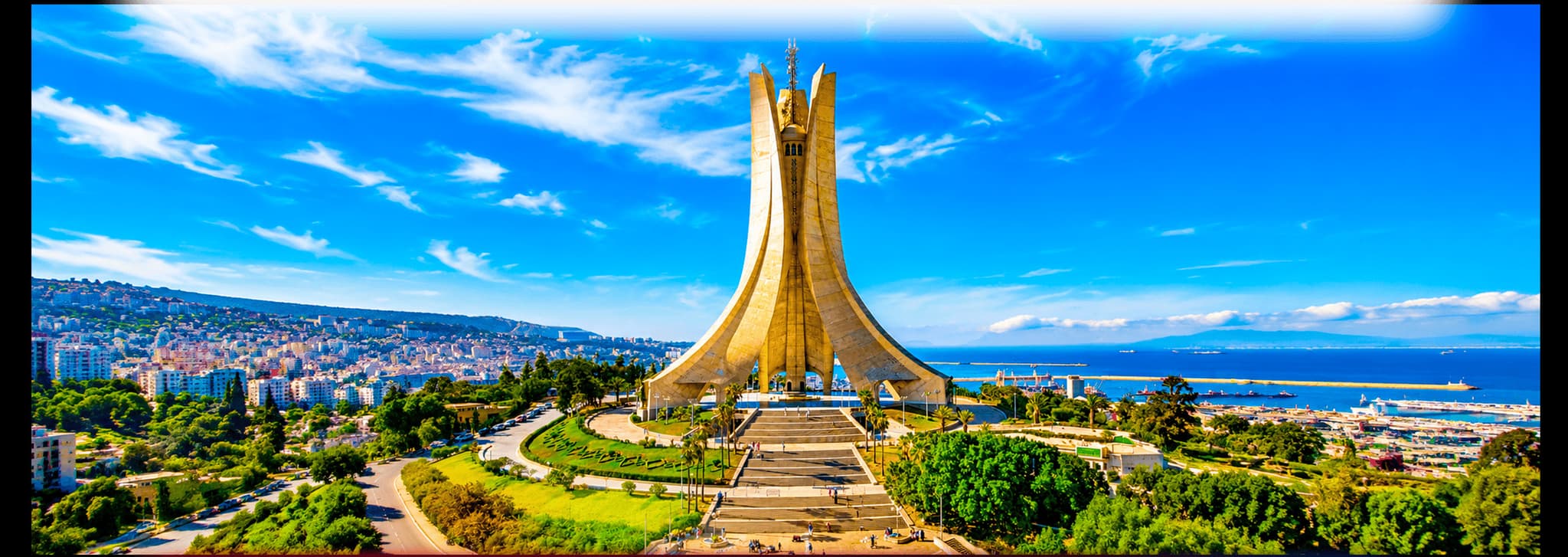
The Martyr's Memorial (Maqam Echahid)
Three concrete palms 92 metres high dominating the entire city. The Maqam Echahid, inaugurated in 1982 for the 20th anniversary of independence, is one of the most photographed monuments in Algeria. From the esplanade, the panoramic view over the bay of Algiers is spectacular.
Gardens and Green Spaces
The Jardin d'Essai du Hamma
The Jardin d'Essai is one of the most beautiful botanical gardens in Africa. Created in 1832, it spans 32 hectares and houses more than 3,000 plant species — giant ficus, bamboo, century-old palm trees. A true breath of green air at the heart of the capital.
Jardin Sofia (Parc de la Liberté)
A family park right in the city centre, ideal for a break between visits. Free entry, shaded, frequented by Algiers families at the weekend.
Parc des Grands Vents (Dounia Park)
30 minutes from the centre by car, Dounia Park is the green lung of the Algiers suburbs. Ideal for families: picnics, hiking trails, fresh air.
Religious and Cultural Sites
The Basilica of Notre-Dame d'Afrique
Perched on the heights of Bab El Oued, the Basilica of Notre-Dame d'Afrique offers one of the finest views over the bay of Algiers. The building, constructed in 1872, blends Byzantine, Romanesque and Islamic architecture. Inside, an inscription recalls that the basilica prays for Christians and Muslims alike.
Ketchaoua Mosque
At the heart of the Casbah, the Ketchaoua Mosque is a symbol of Algiers' turbulent history. Built during the Ottoman era, converted into a cathedral under colonisation, returned to Islamic worship at independence. Its architecture blends marble columns, domes and minarets.
The Bardo Museum
Housed in an 18th-century Ottoman palace on Boulevard Didouche Mourad, the Bardo Museum holds remarkable ethnographic and prehistoric collections. Very affordable entry (around 200 DA).
The National Museum of Antiquities
Right next to the Jardin d'Essai, this museum preserves unique Roman, Punic and Berber pieces — mosaics, statues, jewellery. Essential for anyone interested in Algeria's ancient history.
Neighbourhoods and Panoramas
The Seafront — Boulevard Zighout Youcef
Algiers' maritime promenade. At sunset, Boulevard Zighout Youcef comes alive: families, joggers, peanut vendors. The view over the bay and the port boats is one of the city's finest postcards.
The Télemly District / Balcon Ezzahira
Less known to tourists, Télemly is a residential district perched on the heights with breathtaking views over the bay. The Balcon Ezzahira is the ideal photo spot to capture Algiers the White in all its splendour.
Practical Tips for Visiting Algiers
A few pointers before you go:
- Best period: April–June and September–October. In July–August, the heat can exceed 35°C — outdoor visits become gruelling.
- Transport: the metro (line 1) covers the centre and serves the Jardin d'Essai. The El Madania cable car links the Jardin d'Essai to the Martyr's Memorial. Minibuses cover Bab El Oued and Notre-Dame d'Afrique.
- Safety: do not photograph official, military or police buildings. Keep your identity documents on you at all times.
- Budget: entry fees between 0 and 200 DA. A local meal (popular restaurant) from 300–500 DA. Public transport is very affordable.
- Recommended duration: 2 days to see the essential centre. 3 days to add the peripheral sites (Dounia Park, Notre-Dame d'Afrique, Télemly).
Why Rent a Car in Algiers to Explore the City?
The metro and minibuses cover the centre well. But as soon as you want to venture off the beaten track, public transport shows its limits.
Dounia Park, Sidi Fredj, the beaches of the West Coast: inaccessible without a car. Notre-Dame d'Afrique in the evening, the Balcon Ezzahira at sunset: the last minibuses left long ago.
With Safar El Amir, you benefit from unlimited mileage — no meter running while you explore. And if you arrive directly from the airport, delivery is available from the moment you land.
Check our rates for car rental in Algiers or book directly from the airport with our Algiers airport car rental service.
Frequently Asked Questions
What are the must-see places to visit in Algiers?
The 12 sites not to miss: the Casbah (UNESCO), La Grande Poste, the Martyr's Memorial, the Jardin d'Essai du Hamma, Jardin Sofia, Dounia Park, the Basilica of Notre-Dame d'Afrique, Ketchaoua Mosque, the Bardo Museum, the National Museum of Antiquities, the seafront boulevard Zighout Youcef, and the Balcon Ezzahira in Télemly. The Casbah and the Jardin d'Essai are often cited as the two absolutely top-priority visits.
How many days do you need to visit Algiers?
2 days are enough to cover the central sites (Casbah, Grande Poste, Jardin d'Essai, seafront). Allow 3 days if you want to add Notre-Dame d'Afrique, Dounia Park and the hilltop neighbourhoods. A week allows you to also explore the West Coast (Sidi Fredj, Zéralda) and the surrounding area.
How do you get around Algiers to visit tourist sites?
The metro (line 1) is the most practical way for the centre: it serves La Grande Poste (Tafourah station), the Jardin d'Essai (eponymous station) and several central districts. Minibuses complement coverage towards Bab El Oued and Notre-Dame d'Afrique. For peripheral sites (Dounia Park, Télemly, West Coast), a car is essential.
What places to visit in Algiers as a couple?
The Balcon Ezzahira in Télemly at sunset, the seafront promenade at dusk, and a morning stroll through the alleyways of the Casbah are the most romantic experiences. Notre-Dame d'Afrique, with its view over the bay, is also a very popular spot for couples. For these evening or peripheral visits, a car will give you all the freedom you need.
What is the best time to visit Algiers?
April–June and September–October are ideal: mild temperatures (20–28°C), little rain, tourist sites accessible without the summer crowds. Avoid July–August if possible — the heat is intense and some sites close earlier. Winter (December–February) is mild but rainy.