
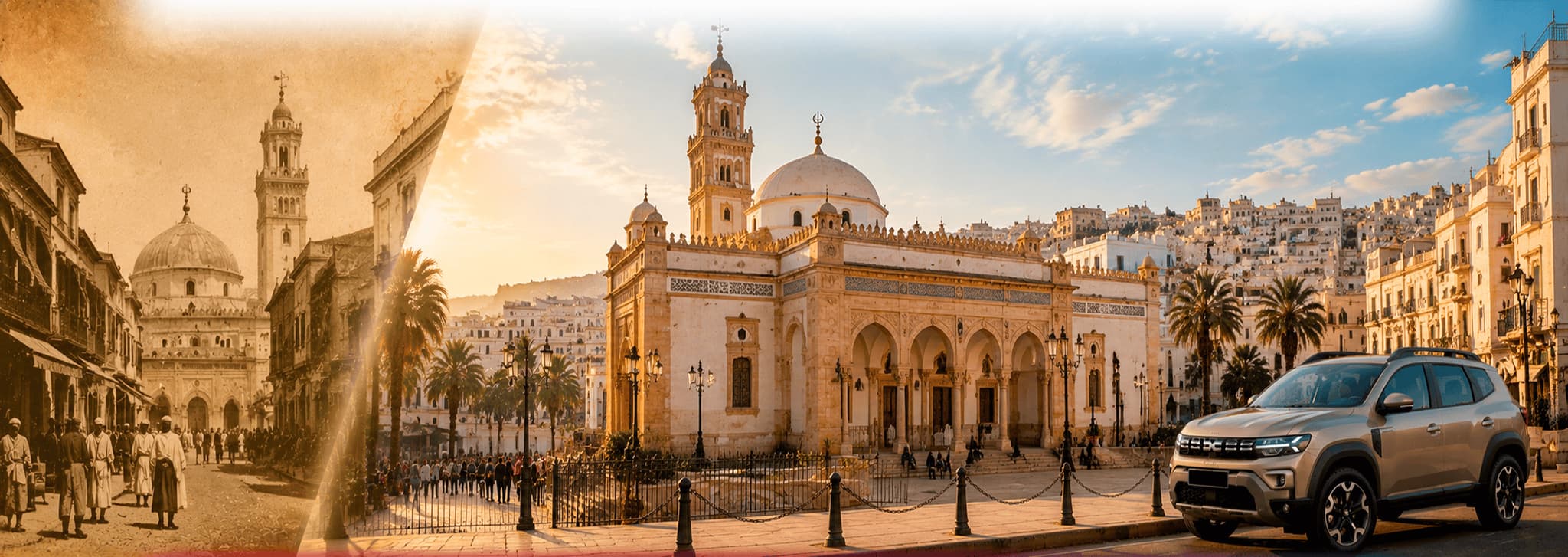
Why Rent a Car to Visit the Casbah?
The Casbah is explored on foot — but Algiers itself is best discovered by car.
Between the Ketchaoua and the Hamma Botanical Garden, there are 4 km. Between the Casbah and the Martyrs' Memorial, 3 km. And Notre-Dame d'Afrique is 8 km to the northwest. Using public transport to chain these sites together takes half a day of commuting. With a rental car, you set your own pace.
- Total freedom over your schedule: no reliance on buses or taxis
- Easy access to outlying sites (Notre-Dame d'Afrique, Bois des Arcades)
- Ability to store your belongings in the boot while exploring the Casbah on foot
- Comfort for airport–hotel–site transfers
Rent an experience, not just a car.
From 2,000 DA/day, all categories available. Delivery to your hotel or to Algiers Airport.
View our rental offers in AlgiersA History in Three Acts
Ottoman Mosque (15th–18th century)
The Ketchaoua Mosque was born in the 15th century. Its first construction dates to 1436, built by the Rebai tribe on a site known as "the plateau of the goats": Keçi Ova in Ottoman Turkish, from which the name Ketchaoua derives.
The first documented mention dates to 1612: a land endowment deed (habous) precisely locates it in the Lower Casbah. The building was enlarged around 1613 under the Ottoman Regency.
In 1794, Dey Hassan (in power from 1791 to 1798) ordered a major reconstruction. It is this version that gave the mosque its definitive Ottoman form. A chronogram placed at the entrance commemorates the event, and calligraphed Quranic verses adorn the walls — signed by master calligrapher Ibrahim Jakarhi.
At that time, Ketchaoua was already one of the most prestigious mosques in Algiers: a geographical landmark, a thoroughfare, and a symbol of Ottoman power in the medina.
Saint-Philippe Cathedral (1832–1962)
After the capture of Algiers in 1830, French authorities requisitioned habous properties. The Ketchaoua Mosque was targeted as early as December 1831: the Duke of Rovigo ordered its occupation. Around 4,000 worshippers barricaded themselves inside to resist. The forced entry triggered a massacre — an episode that would later give its name to the Place des Martyrs, just below.
From 1832, the mosque became the first Catholic place of worship resulting from the conversion of an Ottoman mosque in Algeria. In 1838, Pope Gregory XVI elevated it to the rank of cathedral by the bull Singulari divinae.
Between 1844 and 1846, the old mosque was demolished. Architect Amable Ravoisié drew up the plans for the new Saint-Philippe Cathedral, built on a footprint five times larger. Albert Ballu completed the current façade in 1890. Two bell towers of Eastern inspiration flank the monumental entrance at the top of a 23-step staircase.
In 1868, a bell — known as the "Augustine bell" — was installed. It was donated in 1965 to a Breton chapel (Le Vieux-Marché), where Louis Massignon had established an Islamic-Christian pilgrimage during the war of independence.
Return to Mosque (1962–present)
On 2 November 1962, the Ketchaoua Mosque held its first Friday prayer in 130 years. The reconversion was officially marked at a ceremony chaired by Tawfiq al Madani, Minister of Ports, on Place Ben Badis.
In 1992, the mosque was inscribed on the UNESCO World Heritage List along with the entire Casbah of Algiers.
In 2008, the building closed for works — damage caused by the 2003 earthquake required urgent intervention. In 2013, during President Erdoğan's visit to Algiers, Turkey committed to funding a complete restoration. A protocol was signed with the Algerian Ministry of Housing.
Works began in September 2014 and concluded on 28 February 2018. The mosque officially reopened in April 2018, inaugurated by President Bouteflika. During the restoration, the minarets were dismantled stone by stone — each block numbered — and stones too deteriorated were replaced with stones from Sidi Bel-Abbès sharing the same chemical properties. A Roman mosaic was discovered beneath the floor during excavations.
Architecture and Decoration
The Ketchaoua Mosque is a unique case: it carries the successive layers of its history in its very stone.
Plan and Structure
- Elongated basilica plan (known as the "Jesuit plan") inherited from Saint-Philippe Cathedral
- Wide central nave covered by a barrel vault, with smaller side naves
- Shallow transept, surmounted by an octagonal dome at the crossing
- Monumental entrance via 23 steps, portico adorned with four black-veined marble columns
The Façade
Two octagonal minarets frame the façade — former converted bell towers, inspired by Egyptian Mamluk architecture. The façade, designed by Albert Ballu (1890), blends Gothic vocabulary with Oriental ornaments: a hybrid result, the product of a hybrid history.
The Interior
- Prayer hall with a capacity of approximately 1,200 worshippers
- White marble columns, several of which belong to the original mosque
- Mihrab adorned with gold-leaf calligraphy, created during the 2018 restoration by Turkish master Hüseyin Kutlu
- Minbar (pulpit) dating from 1794, restored
- Geometric-patterned sapele wood screens separating the main hall from the women's prayer space
- Quranic verses adorning the walls of the prayer hall
Visiting the Ketchaoua Mosque
Access and Location
The mosque is located on Ibn Badis Square, in the Lower Casbah of Algiers, adjacent to Dar Hassan Pacha (the former winter palace of the Governor-General).
- Metro: Place des Martyrs station (line 1) — 5 minutes on foot
- On foot from the Grande Poste: approximately 15 minutes walking up towards the Casbah
- By car: parking is difficult in the Casbah; it is preferable to park at Place des Martyrs or near the port and continue on foot
Practical Tips
- Dress code: modest dress is mandatory for all (shoulders and knees covered). Women must cover their heads inside. A spare headscarf is useful.
- Prayer times: avoid the 20–30 minutes surrounding each prayer (Fajr, Dhuhr, Asr, Maghrib, Isha). Visits are possible between prayers.
- Best time: in the morning (9am–11am) for light and tranquillity. Avoid Friday lunchtime.
- Recommended duration: allow 45 minutes to 1 hour to appreciate the exterior and interior.
- Access for non-Muslims: possible outside prayer times, in the areas designated for this purpose (maksourah). Ask on site for the day's arrangements.
- Entry: free.
Combining with Other Sites
The Ketchaoua is the ideal starting point for a day in the Casbah. Here is a logical itinerary:
- 🕌 Ketchaoua Mosque — entry point to the Lower Casbah
- 🏛️ Dar Hassan Pacha — adjoining Ottoman palace
- 🗼 Palais des Raïs (Bastion 23) — a few minutes' walk away
- 🌿 Casbah alleyways — climb towards the Citadel
- 🌊 Panorama over the Bay of Algiers — from the heights
To find out everything about the Casbah: see our complete guide to the Casbah of Algiers.
All things to do in Algiers: What to do in Algiers?
Frequently Asked Questions
Is the Ketchaoua Mosque open to non-Muslims?
Yes, visits are possible for non-Muslims outside prayer times. Designated areas (maksourah) are available to welcome tourists. Modest dress is essential. Ask on site upon arrival to confirm the arrangements for the day.
What are the visiting hours?
The mosque is open between the five daily prayers. In practice, the most favourable windows are 9am–11:30am and 2pm–4pm (times vary according to the season and prayer schedule). Avoid Friday lunchtime (Joumouaa prayer).
How do I reach the Ketchaoua Mosque from central Algiers?
The mosque is located on Ibn Badis Square in the Lower Casbah. From Place des Martyrs (metro line 1, Place des Martyrs station), allow 5 minutes on foot. From the Grande Poste, approximately 15 minutes on foot walking up towards the Casbah. By car, park at Place des Martyrs or near the port.
What makes the Ketchaoua Mosque architecturally unique?
It is one of the rare monuments in the world to combine three superimposed architectural identities: a 17th-century Ottoman mosque, a 19th-century Neo-Byzantine cathedral, and an Algerian mosque restored in 2018. Its basilical plan, octagonal dome, minaret-bell-towers and gold-leaf calligraphy make it a unique architectural object in the Mediterranean.
Can you visit the Ketchaoua Mosque and the Casbah in one day?
Yes, very easily. The Ketchaoua is the natural entry point to the Casbah. Allow 1 hour for the mosque, then 2 to 3 hours to explore the alleyways, Dar Hassan Pacha and the Palais des Raïs. A full morning is sufficient. In the afternoon, you can continue to the Hamma Botanical Garden or the Martyrs' Memorial.