
How to Get to the Martyrs' Memorial
Three options, depending on your starting point and preferences.
By Car (Recommended)
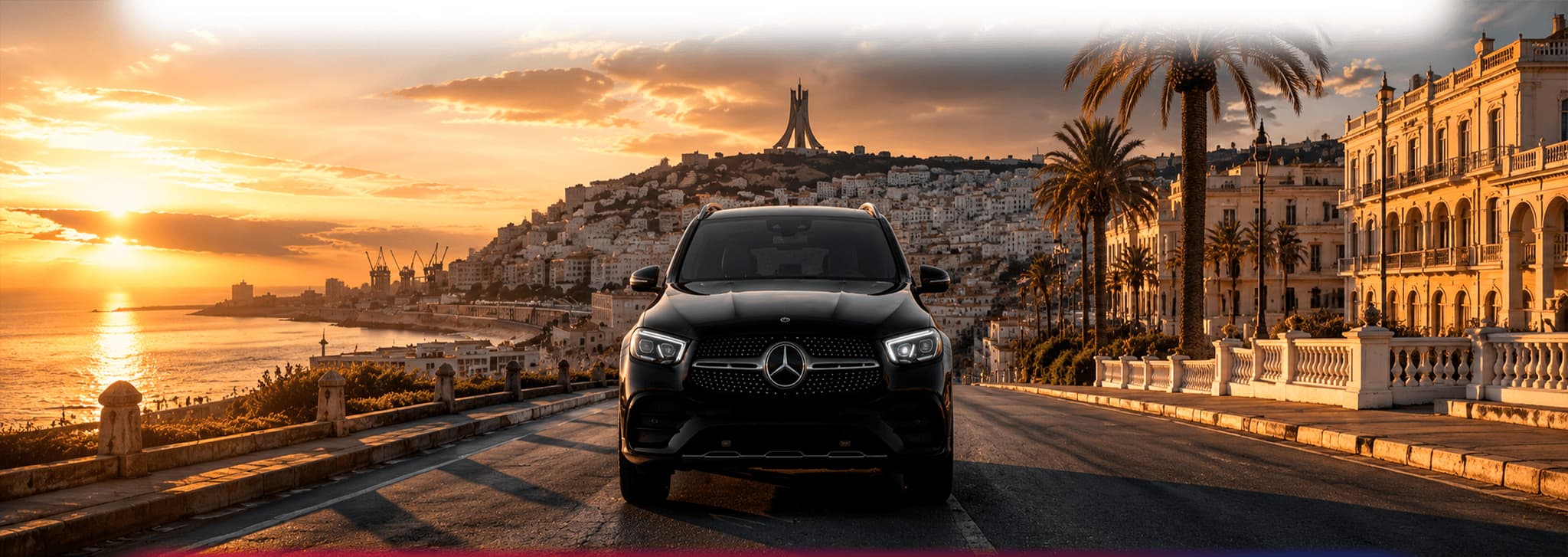
From the city centre, allow 15 minutes in normal traffic to El Madania. Renting a car in Algiers with Safar El Amir gives you total freedom to combine several sites in one day. You can also rent directly at Algiers Airport.
A 3-level underground car park (~1,200 spaces) is available beneath the Riadh El Feth shopping centre esplanade, right next to the monument. Paid, but inexpensive — and you're a short walk from the esplanade.
By Taxi
Simply say "Makam Echahid" to the driver — everyone knows it. From the Grande Poste or Place Audin, allow 10 to 15 minutes depending on traffic.
By Cable Car
This is the most original option. The Memorial cable car links the Jardin d'Essai du Hamma directly to the esplanade. Ideal if you combine both sites in the same day.
History and Symbolism of the Makam Echahid
The project was born under the presidency of Houari Boumédiène, but it was his successor Chadli Bendjedid who brought it to completion. The monument was inaugurated on 5 July 1982, exactly twenty years after Algerian independence — a deliberately chosen date.
It was built on the site of a former military fort in the El Madania district, as a tribute to the chahids: the fighters of the National Liberation War (1954–1962) who died for the country's independence. The 3 palms symbolise three revolutions carried by independent Algeria:
- The cultural revolution
- The agrarian revolution
- The industrial revolution
They also represent three periods of national history: resistance to colonisation, the war of liberation, and the future of the country. At the centre, beneath the vault formed by the joining palms, burns an eternal flame — a symbol of the enduring memory of the martyrs. The monument even appears on the front of the first 200 Algerian dinar banknote.
Architecture: The 3 Concrete Palms
From a distance, the Makam Echahid looks like a stylised flower. Up close, the effect is striking.
| Specification | Value |
|---|---|
| Total height | 92 metres |
| Palm junction | at 47 metres |
| Material | Reinforced concrete |
| Artistic designer | Bachir Yellès (Algerian artist, Algiers School of Fine Arts) |
| Builder | Canadian firm Lavalin |
| Statue sculptor | Marian Konieczny (Polish artist) |
At the base of each palm stands a large bronze statue signed by Konieczny. Each represents a different fighter: a moudjahid (ALN guerrilla from the interior), a soldier from the border ALN, and a soldier of the ANP (the current Algerian army). These three figures tell the story of the continuity of Algerian resistance. Take the time to observe them up close — the detail is impressive.
The National Moudjahid Museum
Beneath the esplanade lies one of the most comprehensive museums in Algiers on the independence war: the National Moudjahid Museum, opened in 1984. The tour is chronological and covers:
- Popular resistance from Emir Abdelkader up to the 1950s
- The launch of the revolution on 1 November 1954
- The Battle of Algiers (1957), the massacres of Sétif, Guelma and Kherrata
- Archives, weapons, personal objects, photographs and reconstructions
- A room dedicated to the Évian Accords and independence
The tour ends in an underground dome decorated with calligraphed Quranic verses, with a permanent Quranic recitation — a deeply moving moment of contemplation.
Panoramic View from the Esplanade
This is one of the finest views in Algiers. From the Makam Echahid esplanade, the eye travels over:
- Algiers Bay and its curves
- The Mediterranean Sea on the horizon
- The Belouizdad and Hamma districts, and the Jardin d'Essai du Hamma below
- The white city cascading down towards the port
Best time for photos: late in the day, between 5 and 7 pm depending on the season. The raking light gilds the façades and the sea takes on orange hues. This is also when the esplanade comes alive with Algerian families.
Combining with Other Sites
The Martyrs' Memorial lends itself perfectly to a full day on the heights of Algiers.
- 🌿 Morning: Jardin d'Essai du Hamma — beautiful botanical gardens, ideal for a morning stroll. Then take the cable car up directly to the Makam Echahid.
- 🏛️ Midday: National Moudjahid Museum (1h) then lunch at one of the Riadh El Feth esplanade restaurants.
- ⛪ Late afternoon: Notre-Dame d'Afrique — the basilica perched on the heights, reachable by car from El Madania in 15 minutes. The view over the bay at the end of the day is equally spectacular.
This circuit covers the most iconic Algiers sites in a single day. For more ideas, see our complete guide to things to do in Algiers. With a car, you can add the Casbah in the evening.
To visit these sites without timetable constraints, a car is essential. Safar El Amir delivers your vehicle to your hotel.
Rent a car in AlgiersExpert Advice from Safar El Amir
Expert in Algerian mobility for 22 years
What aspect of the Memorial surprises visitors most?
What surprises almost everyone is the real scale of the monument. You see it from all over the city, you think you know it — and then you arrive at the foot of the palms and realise that 92 metres is enormous. The bronze statues at the base are easily 5 to 6 metres tall, and you don't expect that. The underground museum also surprises people: many visitors don't know it exists, and yet it's one of the most moving experiences of the visit.
Why do you recommend a car over a taxi for this visit?
With a car, you control your own time. You can stay on the esplanade until sunset, then head to Notre-Dame d'Afrique or drive back to the centre without depending on available taxis. The Riadh El Feth car park is large, well-located, and gives you total freedom to organise your day.
What is the best sequence of sites for a full day in Algiers?
Jardin d'Essai in the morning (cool, calm), cable car up to the Makam Echahid, Moudjahid Museum before lunch, then Notre-Dame d'Afrique in the late afternoon. With a car, you can add the Casbah in the evening. It's a packed day but perfectly doable — and you come home with a genuine understanding of Algiers.
Frequently Asked Questions
Is the Martyrs' Memorial free to visit?
Access to the esplanade and the exterior monument is entirely free. The National Moudjahid Museum, located underground, charges a very symbolic fee (a few dozen dinars). Exact prices are not published online — enquire on site at the museum entrance.
Can you visit the underground museum?
Yes. The National Moudjahid Museum is accessible from the esplanade. It traces the history of Algerian resistance through archives, weapons, personal objects and reconstructions. Allow about 1 hour for the full tour. Note that photography may be prohibited inside — check the rules at the entrance.
How do I get to the Martyrs' Memorial from Algiers city centre?
Three options: by car (15 min from the centre, Riadh El Feth car park), by taxi (say "Makam Echahid" to the driver, 10–15 min), or by cable car from the Jardin d'Essai du Hamma. A taxi is the simplest for a one-way trip; a car is ideal if you're combining several sites.
How long does it take to visit the Martyrs' Memorial?
Allow about 2 hours for a complete visit: esplanade + statues + underground museum. If you add time on the esplanade to enjoy the panoramic view, allow 2 hours 30 minutes.
Can you take photos at the Martyrs' Memorial?
On the outdoor esplanade, yes — and the photos are magnificent, especially late in the day. Inside the museum, photography may be restricted or prohibited. Check at the museum entrance before taking out your camera.