
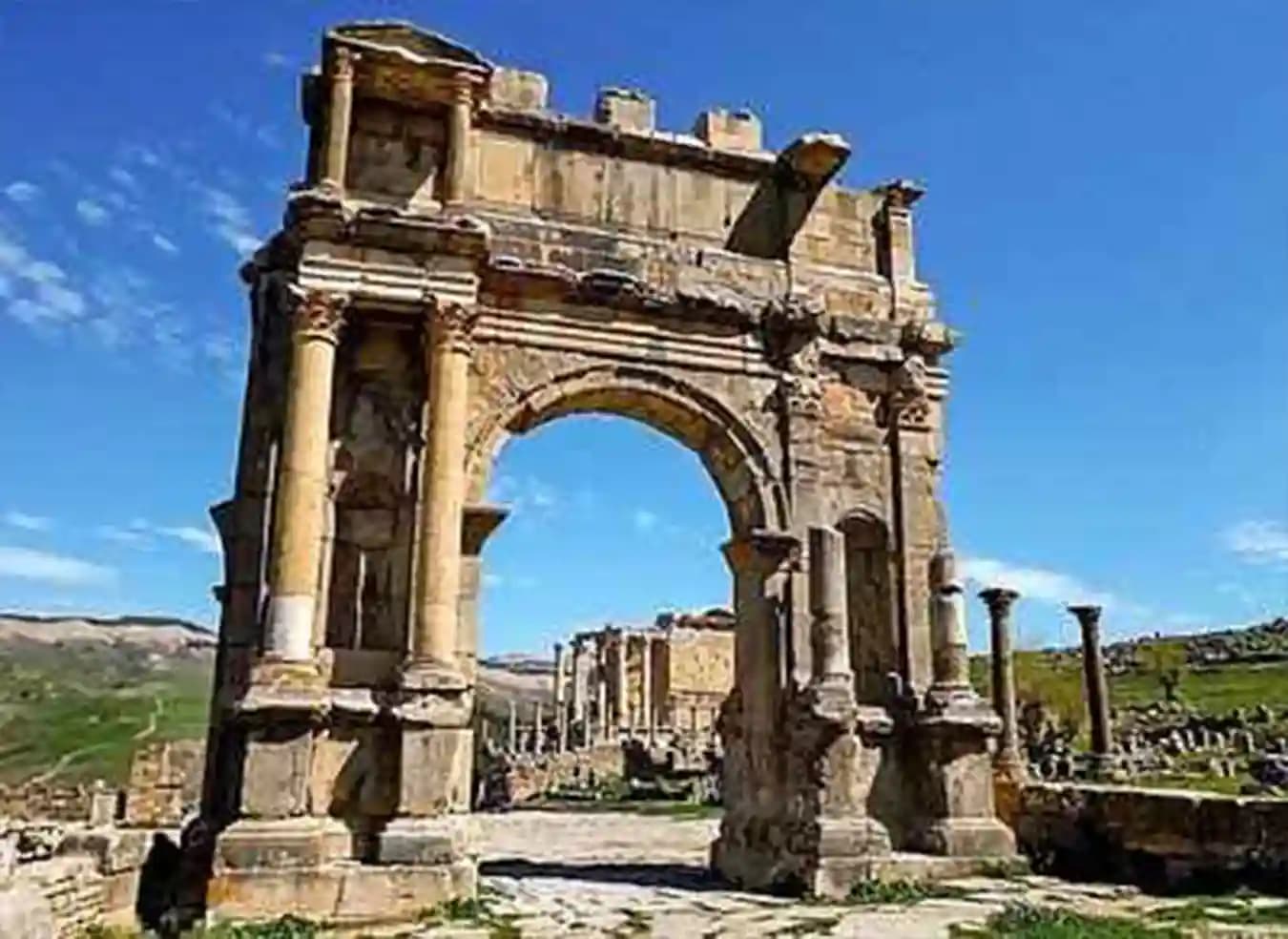
Cuicul, a Roman colony on the High Plateaus
Cuicul sat at a strategic crossroads, between the road linking Igilgili (Jijel) to Lambaesis and the one joining Cirta (Constantine) to Sitifis (Setif). The colony is thought to have been founded around AD 96 to settle veterans, probably under Emperor Nerva, although historians still debate it. Along with Timgad, it was one of the last colonies of this kind founded in Roman Africa.
Under the Antonines, the city gained a forum, a capitol, temples, a curia, a market and a theater. At the end of the 2nd century, large baths accompanied its expansion to the south, and Christianity later gave rise to a whole new quarter. In 1982, the exceptional state of the ruins earned the site its UNESCO World Heritage listing.
What to see at Djemila
The old city and the forum
To the north, the cardo maximus leads to the forum, civic heart of the original town, lined by the capitol, the curia and the so-called Cosinius market. Together they explain the layout of a Roman city better than any textbook.
The Severan square and the Arch of Caracalla
Further south, the vast 3,200 m² esplanade laid out in the late 2nd and early 3rd centuries is dominated to the west by the Arch of Caracalla and to the east by the Septimian temple, dedicated to the family of Emperor Septimius Severus. It is Djemila's most famous view and the best vantage point over the site.
The theater and the great baths
Built into the slope, the theater could seat a few thousand spectators facing the hills. To the south, the great baths built under Commodus show the comfort of Roman urban life.
The Christian quarter
At the southern end, the Christian quarter brings together a baptistery and basilicas. Nearby mansions, such as the House of Europa, reveal the lifestyle of the local elite, with private baths and reception halls.
The site museum
At the entrance to the archaeological park, at the end of a tree-lined path, the museum displays mosaics and objects found at Djemila. Visit it first to better understand the ruins. To go further, the Setif national museum exhibits many pieces from the region.
Visiting Djemila: practical information
- Access: 57 km northeast of Setif (about 1 h), via the East–West Highway heading east, then a provincial road up to Djemila village. From Ain Arnat Airport, allow 64 km.
- Time needed: 2.5 to 3 hours for the site and museum.
- Opening hours: they vary by season; check before you go.
- When to come: spring for green hills, autumn for mild weather. In summer, arrive at opening time as the site is very exposed.
- What to bring: walking shoes, a hat, water and sunscreen; the site is on a slope.
Getting to Djemila from Setif
There is no convenient direct service to the site, and the visit pairs best with other stops. With a rental car picked up at Setif Airport, you can arrive at opening time, have lunch in the village and drive back via Setif in the late afternoon.
Combining Djemila with other visits
Back in Setif, end the day at the Ain El Fouara fountain and the amusement park. The next day, head for the mountains with Mount Babor or the hot waters of Hammam Guergour. All our ideas are in our list of things to do in Setif and the complete Setif guide.
Frequently Asked Questions
Where is Djemila?
Djemila is in Setif province, about 57 km northeast of the city of Setif, an hour's drive.
Why is Djemila a UNESCO World Heritage Site?
For the exceptional state of the ruins of Cuicul, a Roman city adapted to a mountain site. It has been on the World Heritage list since 1982.
What can you see at Djemila?
The forum and capitol, the Severan square with the Arch of Caracalla and the Septimian temple, the theater, the great baths, the Christian quarter and the site museum.
How long does it take to visit Djemila?
Allow 2.5 to 3 hours to walk around the site and visit the museum, plus 2 hours of round-trip driving from Setif.
What is the best season to visit Djemila?
Spring, when the hills are green, and autumn. In summer, come early in the morning to avoid the heat, as the site has little shade.
Sources