
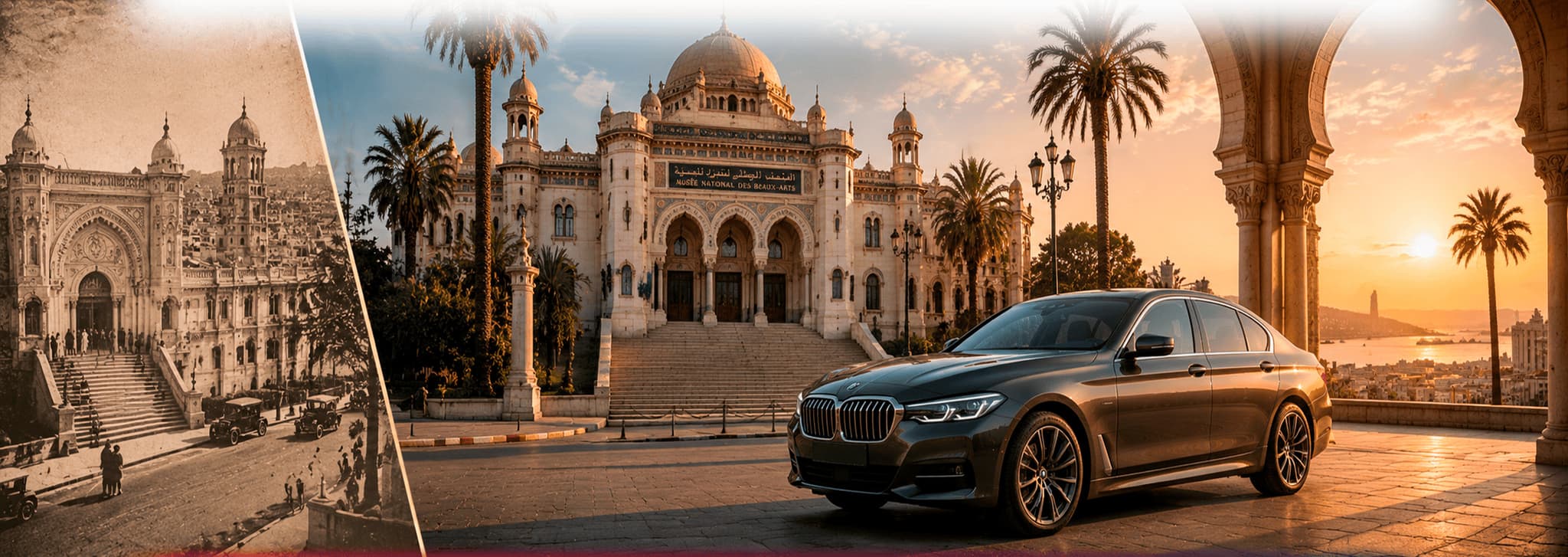
A Moorish Palace at the Heart of 5,000 Years of History
The Musée National du Bardo is one of the most underrated sites in Algiers. Which is a shame. Behind its nail-studded wooden gate hides an 18th-century Moorish palace, nestled in a garden of banana trees and palm trees, housing two exceptional collections: one prehistoric, the other ethnographic.
This is no ordinary museum. It is simultaneously a listed historic monument, a masterpiece of Andalusian-Ottoman architecture, and the only place in Algeria where you can see with your own eyes the skeleton and jewellery of Tin Hinan — the legendary queen of the Tuaregs, discovered in 1925 in the Hoggar.
Two collections, breathtaking architecture, and a centrepiece that leaves a lasting impression. In this guide, you will find everything you need to plan your visit: history of the villa, details of the collections, practical tips, and an itinerary for a full cultural day in Algiers.
Explore Algiers at Your Own Pace with Safar El Amir
The Musée du Bardo is a stop. Not an isolated destination.
To truly make the most of Algiers — Bardo in the morning, the Casbah on foot, Notre-Dame d'Afrique in the afternoon, Jardin d'Essai at the end of the day — you need freedom. Taxis during rush hour can double your travel time. The sites are spread over 15 to 20 km. With a rental car, you set the pace and depend on no one.
Car hire in Algiers with or without a driver, delivered to the Houari Boumediene Airport so you can start your cultural day the moment you land. Also discover the must-sees of Algiers to build your complete itinerary.
See our rental offers in AlgiersHistory of Villa du Bardo: From Summer Residence to National Museum
The Villa du Bardo was built at the end of the 18th century — probably between 1780 and 1790 — by a wealthy exiled Tunisian notable known as Hadj Ben Omar (or Mustapha Ben Omar depending on the source). He designed it as a djenane: an Algerian term for a summer villa where the notables of the time would be received. The name "Bardo" itself comes from Tunis, where the summer palace of the Beys bore this name.
After the French conquest of 1830, the villa changed hands several times:
- 1830: assigned to General Maurice Exelmans
- 1846: property of General Valentin Auguste Lichtlin
- 1851: acquired by the officer-painter Prosper Baccuet
- 1874: Madame Aziza Fao, daughter of merchant Joseph Cohen-Bacri
- 1875: Ali Bey Bouakkaz, Agha of Biskra, who had beautiful oriental frescoes installed
- 1879: Pierre Joret, last private owner, son of the builder of the Algiers–Constantine railway, who extended the lower part without altering the architectural unity
- 1926: Madame Frémont, sister of Pierre Joret, transferred the villa to the French State
In 1930, on the occasion of the centenary of French Algeria, the building was inaugurated as a museum of ethnography and indigenous art. Its first director: Maurice Reygasse, a prehistorian who himself took part in the excavation of Tin Hinan's tomb.
On 1 September 1985, the villa was listed as a historic monument. On 12 November 1985, it took its current name: Musée National du Bardo. Today it also houses the headquarters of the CNRPAH (National Centre for Prehistoric, Anthropological and Historical Research).
Architecture of the Villa: A Unique Moorish Palace in Algiers
The Villa du Bardo is unlike any other Moorish building from the Ottoman period in Algiers. It is a rare and well-preserved example of the 18th-century djenanes — those garden palaces combining Andalusian architecture, Tunisian decoration, and Ottoman lifestyle.
Architectural Elements Not to Miss
- The entrance: steps covered in tilework, a massive wooden door bristling with wrought-iron nails, lush garden on each side
- The central courtyard (~550 m²): marble checkerboard floor, central fountain, stone and marble colonnades — the heart of the villa
- The Pavilion of the Favourite (left wing): gallery of five ogival arches, walls entirely covered in tiles with floral, animal, and geometric motifs
- The Diwan: grand banquet and celebration hall
- The Majlis: reception room raised by two steps, decorated with woodwork
- The Skifa: small waiting courtyard before accessing the private apartments
- The upper level: covered patio with 8 columns, 3 rectangular rooms (concert space)
- The Harem: hammam with a hot room and rest room, wooden furnace for heating the water
- The Khiama (kitchen): with a well, accessible via a few steps down
The total area is approximately 1,650 m². The tiles — mostly imported from Tunisia — adorn courtyards, walls, and exposed-beam ceilings. A Moorish café is also located on the site.
The Collections: 5,000 Years of Algerian History
The museum houses two major collections that complement each other perfectly: one traces the origins of humanity in Algeria, the other tells the story of the rich civilisations that shaped the country up to the 19th century.
Prehistoric Collection: At the Origins of Humanity in Algeria
The prehistoric collection spans millennia of human occupation on Algerian territory. It is organised around four themes: palaeontology, archaeobotany, physical anthropology, and human cultures.
- Palaeolithic and Neolithic objects from Algerian excavations
- Prehistoric figurations and rock engravings from Tassili n'Ajjer
- Ostrich eggs used as containers by prehistoric humans
- Neolithic funerary objects from tumuli and dolmens
- Fossil remains of North African animals: crocodile, elephant, hippopotamus, rhinoceros
- Human remains dating back approximately 750,000 years, discovered at the Acheulean site of Tighennif (Mascara)
- Skull and utensils 14,000 years old, from the Taza region (Jijel)
Tin Hinan, Queen of the Tuaregs: The Museum's Star Piece
This is the piece that leaves every visitor speechless. Without exception.
Tin Hinan is the founding figure of the noble Tuaregs of the Hoggar. Oral tradition describes her as tall, charismatic, and a warrior. Her name in Tamasheq means "she of the tents" or "she who moves" — a reference to the long journey she is said to have made across the Sahara.
In 1925, a Franco-American expedition discovered her tomb near Abalessa, 80 km from Tamanrasset, in the Hoggar massif. In an underground vault protected by stone slabs, the archaeologists found:
- A skeleton lying on its back, covered with fragments of red leather
- Gold and silver jewellery, semi-precious stone beads, bronze objects
- Roman coins bearing the effigy of Emperor Constantine — which date the burial to the 4th century AD
- Arrowheads and an iron spearhead, attesting to her status as a warrior
The anthropological study concluded that this was an exceptionally tall woman — between 1.72 m and 1.75 m. Examination of the bones also revealed that she suffered from lumbar arthritis that made her limp, which echoes Tuareg accounts.
At the Musée du Bardo, you can see Tin Hinan's restored skeleton, her jewellery and funerary objects, and a scale model of her tomb at Abalessa. This is the only museum in Algeria where these pieces are displayed. An experience unlike any other.
Algerian Ethnographic Collection: A Country's Identity in Objects
This section presents the richness of traditional Algerian cultures, from the coast to the Sahara. The objects are classified by theme and by region.
- Musical instruments: string, wind, and percussion — urban and rural orchestras
- 19th-century weapons and harnesses used during revolts against colonisation
- Costumes embroidered in rich fabrics, shoes, babouches, clogs
- Embroidered or metallic headdresses — each region has its own codes
- Copperware and hand-crafted wooden objects
- Silver jewellery: 1,435 gold and silver pieces from the 18th, 19th and 20th centuries, representing all regions — Aurès, Kabylie, Saharan Atlas, Algiers, Constantine, Tamanrasset
- Rural pottery hand-shaped
- Low and high loom weaving, with patterns specific to each region
International Ethnographic Collection: Algeria at the Heart of the World
The museum extends beyond Algerian borders. Its African collection alone numbers more than a thousand pieces dated from the mid-19th century and the early 20th century: 115 sculptures, 58 ceremonial masks, 141 basketry objects, 412 weapons, 41 musical instruments, 22 royal regalia, 57 pieces of jewellery.
Some objects come from the personal collection of the explorer Pierre Savorgnan de Brazza. There are also Maghrebian collections (Moroccan jewellery and pottery, Tunisian costumes, Libyan jewellery), Mauritanian collections (basketry, jewellery), and pieces from the Middle East.
Practical Visit Tips
- Recommended duration: allow at least 1.5 to 2 hours. If you are passionate about history or architecture, plan for 2.5 hours.
- Best time: on weekdays, in the morning between 9am and 11am. The museum is noticeably quieter than in the late morning or at weekends.
- Photography: photography is generally not permitted inside the exhibition rooms — check at the entrance upon arrival. Outdoor spaces (garden, central courtyard) can be photographed.
- Footwear: comfortable shoes. The marble floor of the central courtyard is slippery, and the museum has multiple levels.
- Local guides: available on site to accompany your visit and provide context for the collections.
Sites to Combine in One Day
The Bardo is ideally located for building a full cultural day in Algiers. Here are the sites accessible in the same outing:
- 🏛️ The Casbah of Algiers — 10 min on foot
- 📮 The Grande Poste of Algiers — 15 min on foot
- 🗽 The Memorial of the Martyr — 20 min by car
- 🌿 The Jardin d'Essai du Hamma — 25 min by car
- ⛪ Notre-Dame d'Afrique — 30 min by car
Frequently Asked Questions
Where is the Musée National du Bardo in Algiers?
The Musée National du Bardo is located at 3 Avenue Franklin Roosevelt, in the municipality of Sidi M'Hamed, Algiers (also referenced at 04 Boulevard Amara Rachid, Basse Casbah). It is at the top of Boulevard Didouche Mourad, a few minutes' walk from the city centre.
What are the opening hours of the Musée du Bardo?
The museum is open every day except Sunday and public holidays. On Fridays from 2pm to 5pm, and on Saturdays from 9am to 5pm. Hours on other days should be confirmed directly on site or by phone at 021 64 46 41, as they may vary by season.
What is the entrance fee for the Musée du Bardo?
The entrance fee should be verified directly on site. Algerian national museums generally have very affordable admission prices. Contact the museum at 021 64 46 41 or consult museebardo.dz for the most up-to-date information.
What is the Tin Hinan collection?
Tin Hinan is the legendary founding figure of the noble Tuaregs of the Hoggar. Her skeleton was discovered in 1925 near Abalessa (Tamanrasset), in a tomb dated to the 4th century AD. The Musée du Bardo displays her restored skeleton, her gold and silver jewellery, her funerary objects, and a scale model of her tomb. It is the museum's star piece — and the only exhibition of its kind in Algeria.
How long does it take to visit the Musée du Bardo?
Allow 1.5 to 2 hours for a complete visit of both collections (prehistoric and ethnographic) and the villa's architecture. If you are passionate about history or archaeology, plan for around 2.5 hours. A guided tour is recommended to better understand the context of the displayed pieces.
Can you take photos at the Musée du Bardo?
Photography is generally prohibited inside the exhibition rooms. It is possible to photograph outdoor spaces (garden, central courtyard). Check at reception upon arrival, as rules may change.
How do you get to the Musée du Bardo by car?
The museum is located at the top of Boulevard Didouche Mourad. Parking is available nearby on Boulevard Didouche Mourad. With a rental car, you can easily combine the Bardo with other Algiers sites in the same day — Casbah, Notre-Dame d'Afrique, Jardin d'Essai — without depending on public transport.